Tertl is a real Russian tortoise. She lives in a handbuilt garden kingdom in Saint Paul, Minnesota, eats dandelions from the yard, and explores her entire kingdom for hours every day.
Everything on this page comes from watching her and from the sources tortoise caretakers actually trust: Tortoise Trust, ReptiFiles, and LafeberVet. Where we link to products, those are things Tertl actually uses or that we've researched enough to recommend.
Based on a true tortoise.
§
This page includes affiliate links. If you purchase through them, we may earn a small commission at no added cost to you. We only recommend products Tertl uses or that we genuinely trust.
01
The Species
Russian tortoises (Testudo horsfieldii) are native to Central Asia. Think Kazakhstan, Afghanistan, Iran, Pakistan, northwestern China. Not exactly lush territory. Their natural habitat is dry steppe, rocky grassland, and sparse scrubland, often at high elevation.
In the wild, they're active for about three months out of the year. The rest of the time they're either brumating underground in winter or hiding from summer heat. When they are active, they're grazing on weeds, grasses, and wildflowers, ranging over surprising distances, and avoiding predators like hawks and other raptors. They usually ignore each other unless it's mating time. They're not social animals. They're efficient ones.
Full-grown adults reach 6 to 10 inches in shell length, with females typically running larger than males. Compact, sturdy, and built for environments that would not appeal to most other tortoises. For first-time tortoise keepers, they are often easier to care for since their environment doesn't require tropical heat & humidity like redfoot or sulcata tortoises.
The main tell is the tail. Males have a longer, thicker tail that typically tucks to the side. Females have a shorter, stubbier tail, with the vent (cloaca) sitting closer to the base. In males, the vent is positioned further toward the tip, and the opening is slit-shaped while in females it is star-shaped.
One common misconception: Russian tortoises don't follow the usual rule you might have heard about tortoise sexes. Males do NOT have a concave plastron (the flat underside of the shell). Both sexes look essentially the same from below. Don't rely on that to make the call.
Size matters too. Reliable sexing generally requires a shell length of at least 4.5 to 5 inches. Before that, you're pretty much guessing. Your vet can help when you take them in for their first wellness checkup.
03
Lifespan
With proper care, Russian tortoises live 40 to 50 years. Some sources say longer. They haven't been kept in captivity long enough to be certain. This isn't a "lifespan of a hamster" situation. It's a "this tortoise will outlive the roof on your house" situation. A tortoise is a commitment to caring for them for a long time.
They're not starter pets the way a goldfish is a starter pet. They're starter tortoises; meaning they're a solid entry point into tortoise care if you're actually serious about it, but they do have many specific needs. They are definitely not a cat or dog.
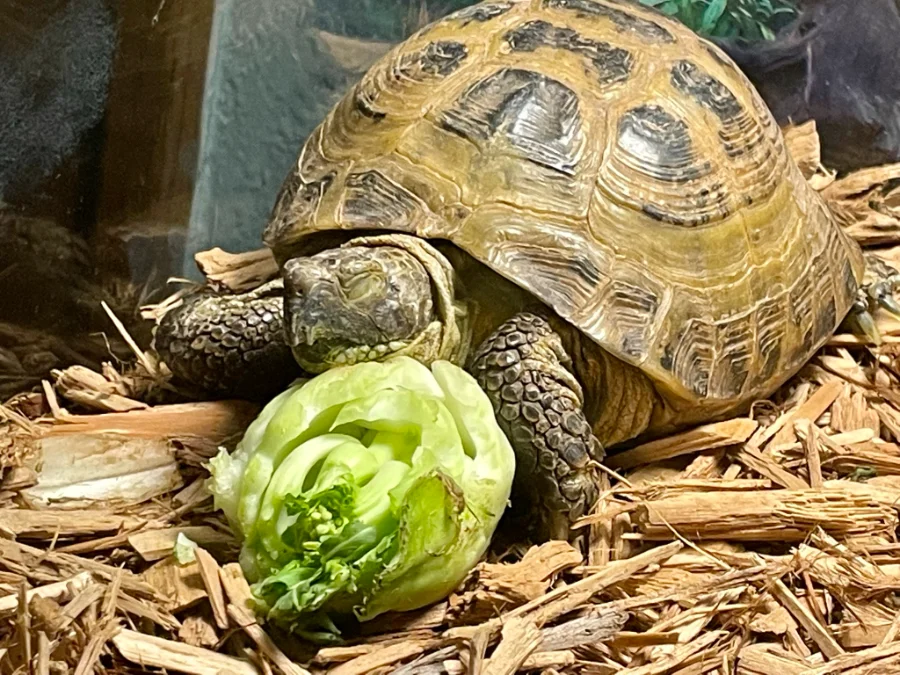
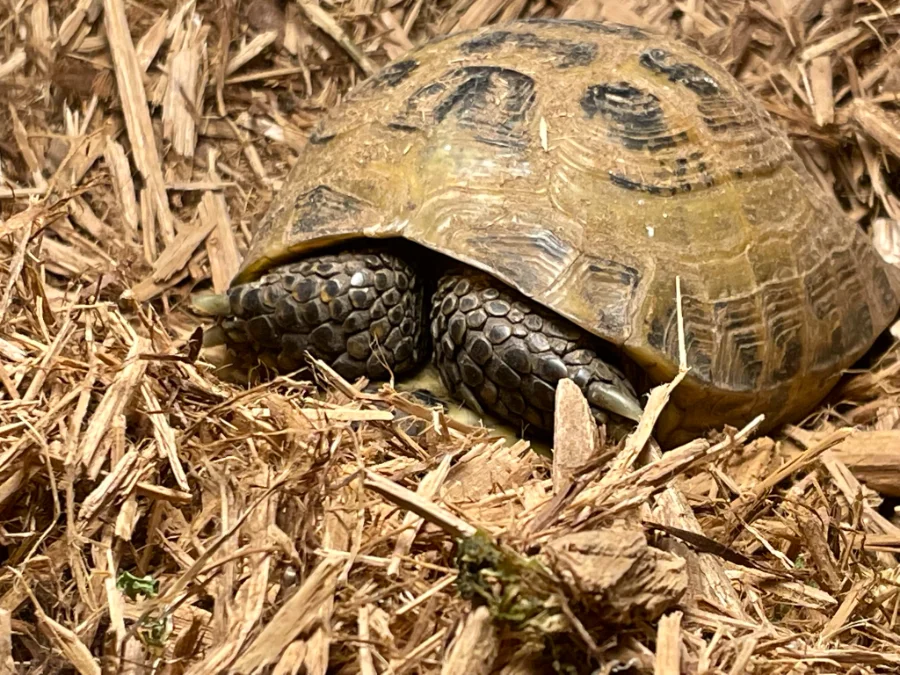
Forty to fifty years of naps like this one.
04
Indoor Care
4a · Enclosure
Room to roam and dig
Russian tortoises need more room than most pet store enclosures suggest. The minimum for one adult is 8 feet by 4 feet of floor space. They're active, they pace, and they dig. A 40-gallon tank is not a permanent solution for a healthy adult Russian tortoise.
Depth matters too. They're strong burrowers. Walls should be solid (not mesh or chain link), at least 12 to 18 inches high, and ideally with an inward lip or overhang. They will attempt escapes. That's not anxiety; that's just what they are. For reference, when she is outside, Tertl has a HUGE outdoor enclosure with four terrain areas, a big hill to climb, a cave, a cottage, a turf area, a rock garden with water feature, and a bridge over to a dedicated pantry garden full of a variety of greens to eat. But sometimes she will still go back & forth in the same three foot area looking for a way to climb out. They can be very, very stubborn, even with lots of enrichment.
4b · Substrate
Deep enough to burrow
The substrate needs to do two things: stay deep enough for burrowing (at least 4 to 6 inches) and hold some humidity without getting soggy or growing mold.
A good starting mix is two parts organic, additive-free topsoil to one part playsand. Coconut coir mixed with topsoil also works well. Avoid pure sand, cedar or pine shavings (toxic), calcium sand, and anything marketed as "reptile carpet." Tortoises ingest substrate when they eat. What goes in the enclosure goes in the tortoise.
Deep substrate isn't decorative — a burrower will use every inch of it.
Tertl's enclosure uses enclosure-grade cypress chips and coconut coir as the primary substrate, with an organic mix in the deeper burrowing area.
4c · Lighting, Temperature & UVB
Warm side, cool side, real UVB
Russian tortoises need a warm basking area, a cool end, and proper UVB. All three matter.
Temperature: The basking spot should reach 90 to 95°F. The cool end should sit in the mid-70s°F. Nighttime temperatures can drop to the mid-60s°F without issue. Below 60°F consistently, and a healthy tortoise will start looking for somewhere to brumate.
UVB: They need it, and they need the right kind. Tortoises need UVB light in order for their shells to absorb calcium. Not enough UVB, and they can get soft shells, a weakened immune system, and metabolic bone disease. In time, this can cause pain, difficulty breathing, and failure to thrive.
ReptiFiles and the Tortoise Trust both recommend a T5 HO 12% UVB bulb (Arcadia or Zoo Med ReptiSun 10.0) in a reflective fixture, placed on the warm side of the enclosure. The target is a UV Index of 3.0 to 4.0 in the basking zone. A Solarmeter 6.5 removes the guesswork from placement if you want to be precise about it.
Light cycles: Replicate seasons. 14 hours of light per day in summer, 10 hours in winter. A basic timer handles this without any effort on your part.
Russian tortoises come from dry climates, but "dry" doesn't mean bone-dry in captivity. Aim for 40 to 60% ambient humidity. The substrate should hold some moisture (it should pack slightly when squeezed, not turn to dust). Too dry and you'll get dehydration and shell problems. Too wet and you'll get respiratory infections. If it gets very dry in the winter, a humidifier in the room can help, but don't put one inside the enclosure. Just dampen the substrate from time to time.
Lightly misting the substrate every few days generally keeps things where they need to be.
4e · Food & Diet
Variety, fiber, and a lot of greens
The foundation of a Russian tortoise diet is variety. The bulk of it should look like what they'd eat in the wild: high-fiber, low-sugar, calcium-rich greens and grasses. Feeding on a slate rock can help keep their beak trim, as does the occasional extra-crunchy item.
Staple Foods
Dark leafy greens are the backbone. Dandelion greens and flowers are the gold standard (and Tertl's unambiguous preference). Collard greens, turnip greens, mustard greens, endive, and escarole all work well. Hay, especially orchard grass or Timothy, adds the fiber and foraging texture that mimics their natural habitat.
Sweet potato is a reliable staple. Nutritious, well-tolerated, and a practical way to get a tortoise to commit fully to dinner.
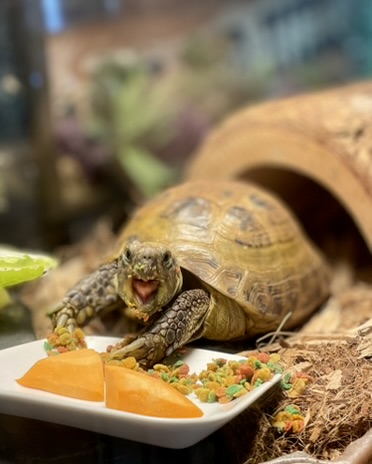
Tertl, committing fully to dinner. Fluker's is the best!!
If you want to grow fresh food, several plants do well in pots or directly in the outdoor enclosure: dandelions, broadleaf plantain (Plantago major), clover, hawkbit, and cat's ear are all safe, nutritious, and genuinely liked. They're also free if you let your yard go slightly feral in the right direction.
A commercial tortoise diet alongside fresh food is a solid safety net. Tertl eats Fluker's Land Tortoise Diet. It's well-reviewed, easy to find, and it works.
Occasional Treats
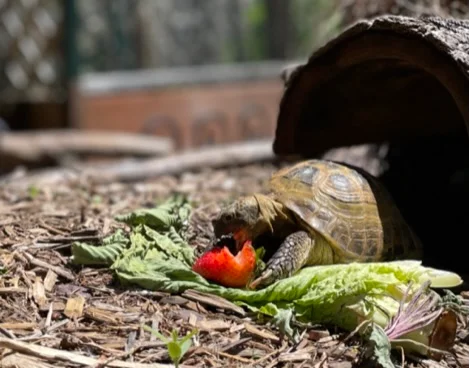
Strawberries, blueberries, melon, and squash can all be offered occasionally. High-sugar fruits should stay infrequent. Think of them the way you'd think of any treat: fine sometimes, a problem if they become the default. Nobody recommends a diet high in candy. That goes for Tertl too. But she does love a good juicy strawberry when they're in season.
A good juicy strawberry, in season.
Foods to Avoid
Avoid high-oxalate vegetables (spinach, beet greens, Swiss chard), which bind calcium and interfere with absorption. Avoid brassicas in large amounts (broccoli, kale, bok choy).
No animal protein, dairy, or anything with added salt, preservatives, or seasoning. Some tortoises do need protein sources like insects or egg whites. Russian tortoises do not.
Iceberg lettuce is nutritionally empty; skip it. It's basically just water. Romaine is OK if offered along with other greens (Tertl LOVES the crunchy stems when it's hot out), but it shouldn't be their main source of greens. No fruit seeds or pits. Nothing from the nightshade family (tomatoes, potatoes, eggplant).
Nothing that's been sprayed with pesticides. Be careful about harvesting dandelions and other weeds from yards & parks if you're not sure.
Russian tortoises drink, but they also absorb water through soaking. Hatchlings especially can dehydrate quickly without regular soaks.
A shallow water dish (one the tortoise can step into and out of easily without tipping it) should be available in the enclosure at all times. Some tortoises use it consistently; some ignore it entirely and rely on scheduled soaks. Both are fine, as long as soaking happens regularly. Tertl hates baths and sometimes she needs to be convinced with a carrot. Tortoises frequently defecate in the water, so you'll need to monitor it often and change it regularly.
Soak juveniles 2 to 3 times per week in warm, shallow water (not hot, not deep) for 15 to 20 minutes. Adults can go to once weekly unless signs of dehydration appear: sunken eyes, wrinkled skin, or unusual lethargy. Always supervise soaking.
4g · Supplements
Calcium, first and foremost
Calcium is the main one. Dust food with plain calcium carbonate (no added vitamin D3 unless your vet recommends it, since the UVB lamp handles D3 synthesis) three to four times per week. Tertl likes a romaine heart with a generous dusting. It's basically her version of a powdered-sugar donut. Keep a cuttlebone in the enclosure too. It's a calcium source the tortoise can self-regulate, and it helps keep the beak worn down.
A complete reptile supplement once a week covers anything the fresh diet misses. We use Repashy Grassland Grazer; a grass-and-flower gel premix you mix and set.
05
Outdoor Enclosure
Russian tortoises can and should spend time outdoors when weather allows. Natural sunlight, unfiltered UV, and the mental enrichment of real terrain do things for a tortoise that no indoor setup fully replicates.
Climate & Temperature
Russian tortoises can tolerate a wider range of conditions than their tropical counterparts, but they still need the right conditions. Below 45F they will start to find a place to brumate. Brumation is controversial. If you and your tortoise are not prepared to brumate, bring them indoors.
Outdoors is appropriate when daytime temperatures are consistently 65°F or above and nighttime temperatures don't drop below 50°F. In Minnesota, where Tertl lives, that window runs roughly from May through September/October. The rest of the year, she's inside.
Don't leave a tortoise outside overnight unless you're certain temperatures will hold above 50°F and the enclosure is secured against nighttime predators. When in doubt, bring her in. Tertl's kingdom today has several security features like fencing and raptor awnings, a rock cave, and a weather-proof temperature-regulated cottage. But for the first few years, she had to come in at night for safety. It's ok if you can't do it all at once.
Enclosure Requirements
Minimum floor space for a single tortoise: 4 feet by 4 feet. Walls need to be solid (not chain link), at least 18 inches above grade, and buried at least 6 to 12 inches below grade to prevent digging out. They will dig out if the opportunity exists. Burying hardware cloth in an L-shape along the perimeter is the standard solution.
The enclosure needs sun exposure and shade. A tortoise that can't get out of the sun can overheat quickly. Native plants, a wooden structure, or shade cloth all work. Cover the top with hardware cloth or similar to contain the tortoise and prevent aerial entry. A water feature can help provide a cooling off area and soaking spot, but be sure to keep it clean and maintained.
Predators
This is the part people underestimate. Russian tortoises are small, slow, and look exactly like something worth grabbing.
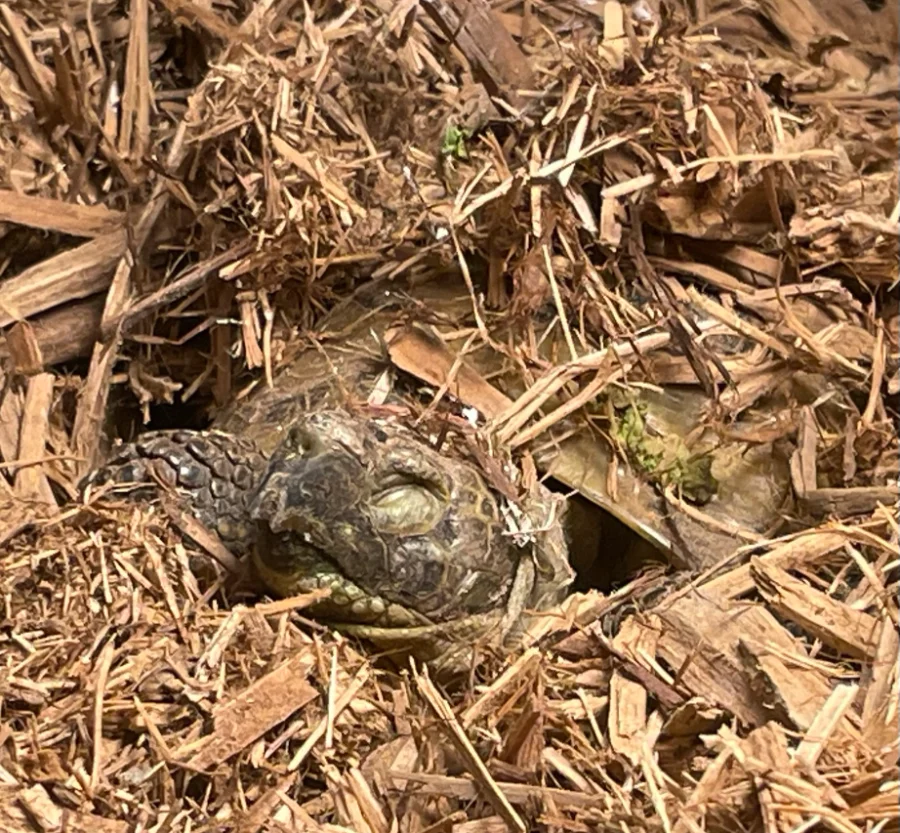
Her whole defense is to become a rock. Help her out with the rest.
Common predators, depending on your area: raccoons, hawks and other raptors, dogs, cats, foxes, coyotes. Overhead netting or solid roofing handles raptors and climbers. The buried perimeter handles diggers. A lid, cover, or secure hide is essential. Don't assume your yard is safe because you haven't seen a predator there.
Terrain & Substrate
A mix of ground surfaces works best: loose substrate for digging, flat rock or slate for basking and beak wear, live plantings where space allows (dandelions and clover count as both habitat and food). Avoid treated wood chips, cocoa mulch, and any ground covering that's been treated with fertilizer or pesticide.
06
Veterinary Care
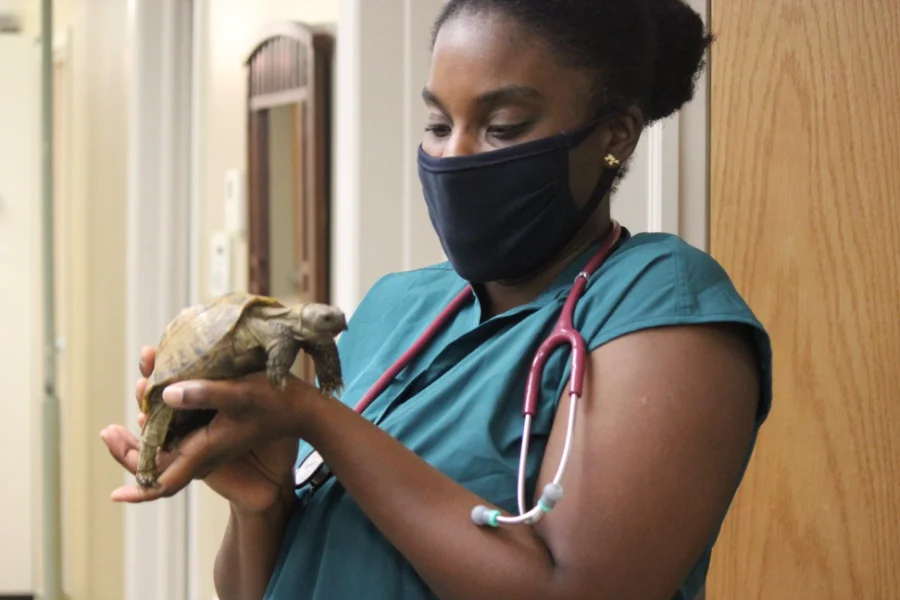
Tertl at her wellness check. Find your reptile vet before you need one.
Find a veterinarian who sees reptiles before you need one. Not all exotic vets have actual experience with tortoises. Ask directly when you call. You'll want to have a wellness check sometime within the first six months to a year for sure.
Basic Maintenance
Beaks and nails grow continuously. In a properly-set-up enclosure with rough surfaces (slate, shale, cuttlebone, varied substrate), both generally self-regulate through normal activity. A tortoise without enough varied terrain may eventually need manual trimming from a vet.
Shell growth should be smooth. Pyramiding (raised, peaked scutes) indicates growth that was too rapid, usually from overfeeding or keeping temperatures too warm & too dry. It's not reversible, but it stops when the underlying conditions are corrected.
When to Call the Vet
Call (or go) immediately for any of the following:
Respiratory symptoms: wheezing, nasal discharge, bubbling at the nostrils, open-mouth breathing, or gurgling. These can progress to pneumonia quickly. Don't wait to see if it clears on its own.
Pink or red lines on the shell or skin, especially near the scute edges. This can indicate septicemia, a bloodstream infection. It's life-threatening and needs same-day attention.
Complete refusal to eat outside of brumation periods, especially combined with lethargy or sunken eyes.
Swollen or closed eyes, soft shell, or a shell that sounds hollow when tapped.
Brumation is the reptile equivalent of hibernation. In the wild, Russian tortoises brumate for months. In captivity, many keepers skip it, especially for indoor-only tortoises in stable conditions. That's a defensible choice. Brumation is optional unless breeding is a goal, but it's worth understanding either way.
Brumation is quite controversial. We cannot recommend brumation for captive tortoises, because every tortoise's situation is different. Brumation can come with some very serious risks and should not be done without the guidance of an exotic-species veterinarian. Generally, if a tortoise is not going to breed, they do not need to truly brumate.
In Tertl's case, she comes inside for the winter. Her indoor enclosure is kept at a cool but not cold average temperature for the season, and the lighting runs a shorter cycle. She spends much of her time burrowed, but not to the extent she would if she were truly brumating for the whole winter.
In the wild, they will dig a deep burrow below the frost line and stay there for months. That can be dangerous for their health, and some tortoises do not survive the process. That is why in captivity you have to be extra diligent about creating the right conditions at the right time. And why you should really talk to your vet about it.
Before You Start
Only brumate a tortoise that is healthy, and that you've kept for at least a year. Don't brumate an animal whose history you don't know, that's been recently treated for illness, or that hasn't maintained a healthy weight through the active season.
Stop feeding 3 to 4 weeks before the target date to allow the gut to clear completely. Continue offering water and soaking during this window. A tortoise that enters brumation with food still in its gut can develop a fatal internal infection. Their metabolism slows and they stop digesting, so any food left in their gut can rot. This risk alone is one reason many keepers avoid brumation.
Weigh the tortoise before brumation starts and check weight monthly. A tortoise should not lose more than 1% of its body weight per month while brumating. Losses above that, call the vet.
Temperature
The target brumation range is 36 to 40°F. Warmer than that and the tortoise burns calories without being truly dormant. Below freezing is fatal. The enclosure needs to hold temperature reliably, with ventilation but no way in for rodents & pests.
Duration
8 to 12 weeks is typical for captive Russian tortoises. Monitor regularly. Have a plan if something looks wrong.